
A SelfSim-Energy Paper Published in Computational Urban Science
Posted on 14 July 2026 by Ding CHEN
Our research group is pleased to share a paper, “Dynamic micro-simulation of domestic electricity consumption: a case of Beijing”, recently published in Computational Urban Science (Vol. 6, Article 42, 2026). Please click here to read the full paper.
Domestic electricity consumption is becoming an increasingly important part of urban energy systems, yet most existing household energy models treat cities as static systems. This study develops SelfSim-Energy, which integrates the SelfSim urban microsimulation framework with an empirically derived household electricity consumption model. Applying SelfSim-Energy to Beijing from 2021 to 2030, this study evaluates how demographic change and land-use planning influence long-term residential electricity demand through two policy scenarios.
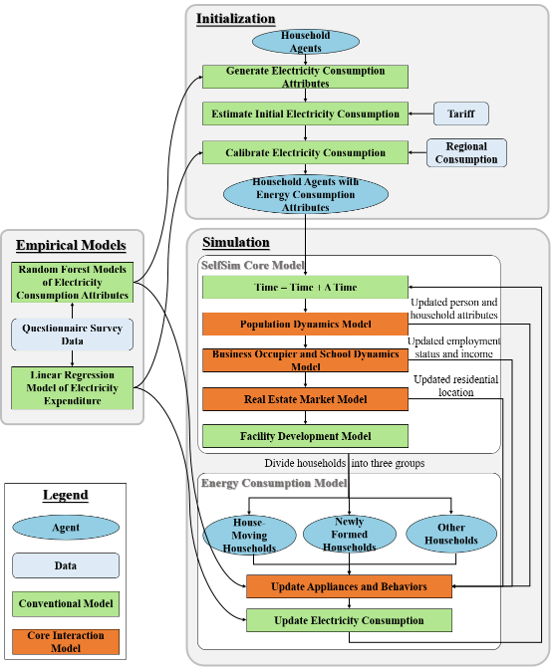
Integrating an empirically based energy consumption module into SelfSim
Key findings include:
- Population growth drives future electricity demand: Total residential electricity consumption increases from 29.1 to 32.3 billion kWh between 2021 and 2030, while average household consumption remains largely unchanged.
- Home ownership influences energy efficiency: Declining home ownership reduces the adoption of energy-efficient technologies such as LED lighting.
- Retirement policies reshape electricity demand: Delaying the retirement age slightly reduces household electricity consumption while shifting demand toward employment-rich districts.
- Land-use planning redistributes electricity demand: Concentrating new development in the Tongzhou Subcenter has little impact on total electricity consumption but shifts electricity demand away from Beijing’s central districts.
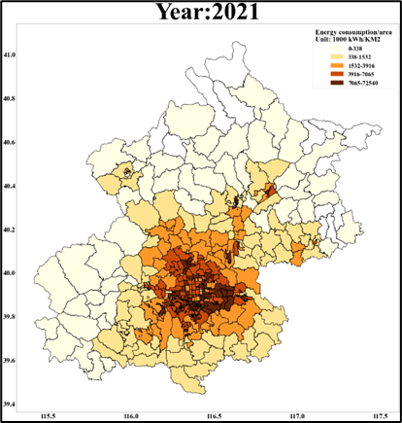 | 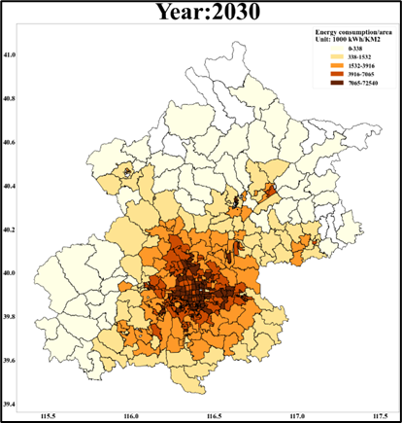 |
| (a) Spatial distribution of electricity consumption in 2021 | (b) Spatial distribution of electricity consumption in 2030 |
Spatial distribution of electricity consumptions in 2021 and 2030