
A Hydrogen Vehicle Paper Published in Transportation Research Part D: Transport and Environment
Posted on 4 March 2026 by Chen Ding
Our research group is pleased to announce that the paper “The Potential Uptake and Climate Impacts of Hydrogen-Fuel-Cell Vehicles in Beijing” has been published in Transportation Research Part D: Transport and Environment (Vol. 154, Article 105253, May 2026). Please click here to read the full paper.
Hydrogen-fuel-cell vehicles (HFCVs) can deliver near-zero life-cycle emissions when supplied with green hydrogen, yet real-world uptake in cities remains limited. To move beyond “static city” diffusion assumptions, this study develops SelfSim-HFCV, a dynamic, spatially explicit agent-based model calibrated to Beijing (2018–2023) and simulated to 2035, allowing demographics, land use, infrastructure deployment, and multi-powertrain competition to co-evolve. We then design three scenario families—urban-form rebalancing through Tongzhou Subcenter growth redirection, a behavioral scenario introducing demographic heterogeneity in consumer preferences, and a policy scenario synchronizing purchase subsidies with hydrogen-refueling-station (HRS) rollout—to test how urban context and policy sequencing shape HFCV diffusion and climate outcomes.
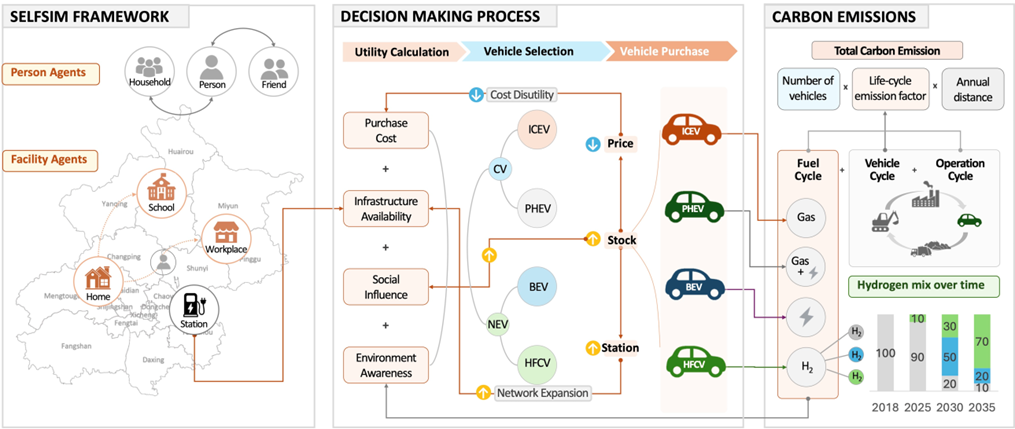
Implementation of the SelfSim-HFCV Beijing model
Key findings include:
- Baseline lock-in: Under baseline conditions, HFCV uptake remains negligible, with BEVs retaining a strong advantage through infrastructure visibility and market maturity.
- Urban form reshapes where, not how much: Redirecting growth to the Tongzhou Subcenter barely changes total HFCV uptake but reallocates charging-station density toward the southeast rather than increasing overall station totals.
- Heterogeneity reveals adopter profiles—but not guaranteed carbon gains: Adding demographic heterogeneity boosts HFCV adoption and identifies adopter “profiles” (e.g., older, wealthier, and concentrated in child-free / retiree / multi-license households), yet higher uptake does not automatically translate into the lowest emissions due to system-level rebounds and multi-technology competition.
- Policy timing matters most: Only coordinated policies—purchase subsidies synchronized with HRS rollout—create sustained shifts toward HFCVs and deliver more consistent emission reductions; HRS rollout alone has limited effect due to scaling delays and weak early-stage observability.
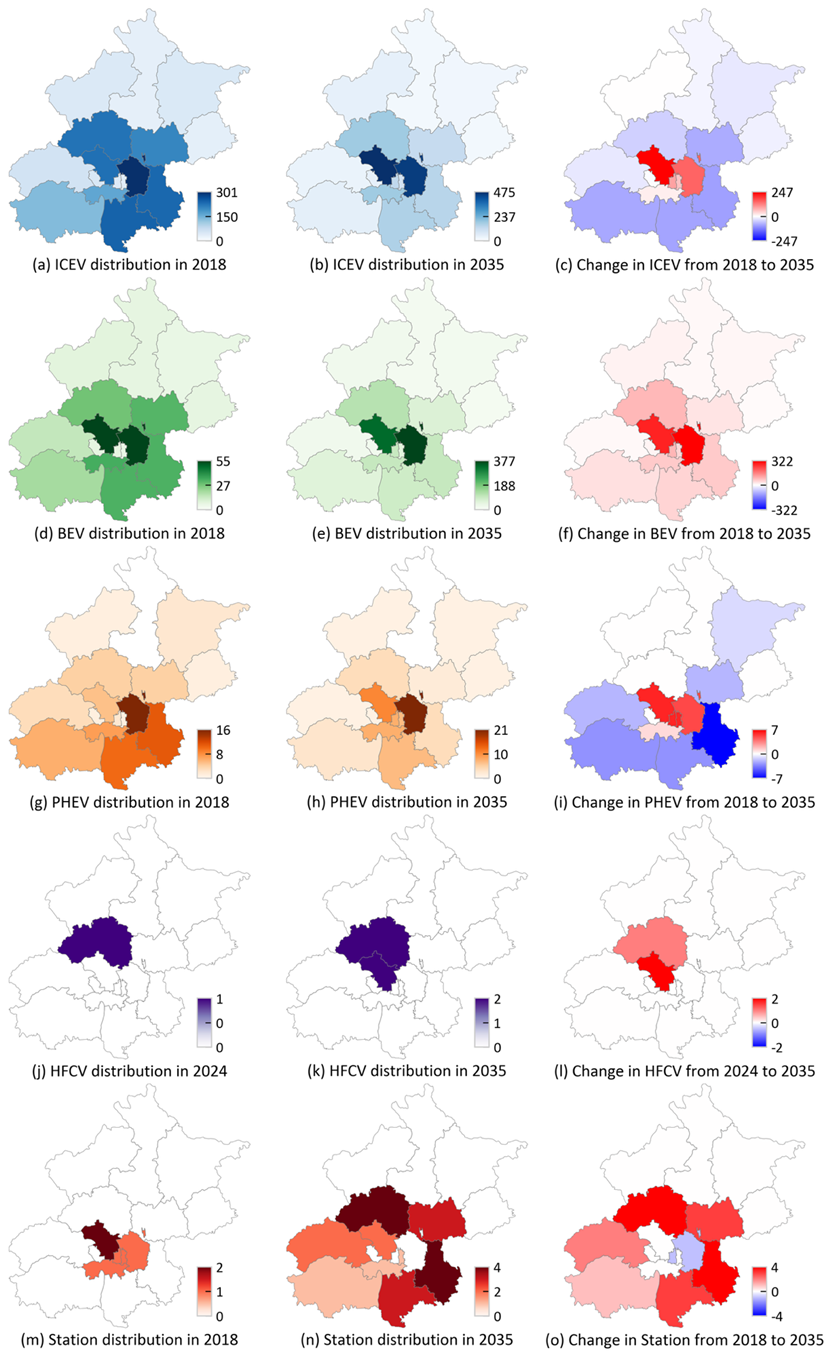
Baseline Scenario: Spatial-Temporal Evolution of Vehicle Adoption and Station Deployment (2018–2035)
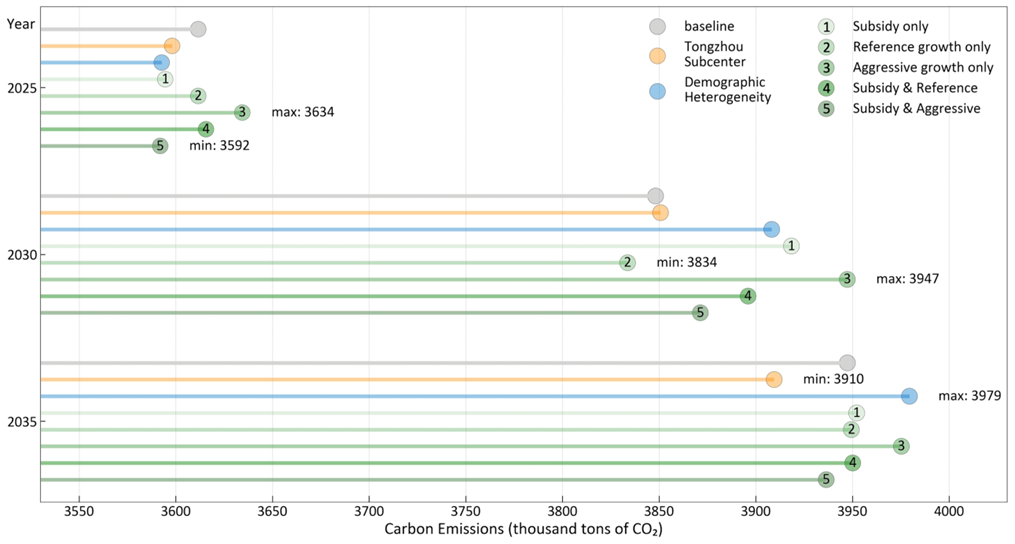
Carbon emissions under alternative scenarios for 2025, 2030, and 2035