
Assessing the dynamic impacts of remote work in New York city
Posted on 2 March 2026 by Chen Ding
Our research group is pleased to announce the research paper “Assessing the dynamic impacts of remote work in New York city” has been published in the Transportation Research Part D: Transport and Environment in Jan 2026! Please click here to read the full paper.
This study explored different Work From Home (WFH) arrangements within urban dynamics. Three scenarios in New York City—fully on-site, fully flexible, and structured hybrid—were designed to evaluate the long-term systematic impacts of WFH on population, economy, and environment from 2020 to 2035. An agent-based land use and transport interaction model incorporating a WFH module (i.e., SelfSim-WFH) was developed to capture the feedback of individuals’ WFH decisions and other associated urban elements.
Key findings include:
- WFH induces a “donut effect,” with decentralization of residence and employment leading to longer home-work distance;
- housing market growth slows, with rents responding more sensitively, while office rent declines;
- environmental gains from reduced commuting are partially offset by longer home-work distance and modal shifts, causing rebound effects in emissions and energy use under certain scenarios.
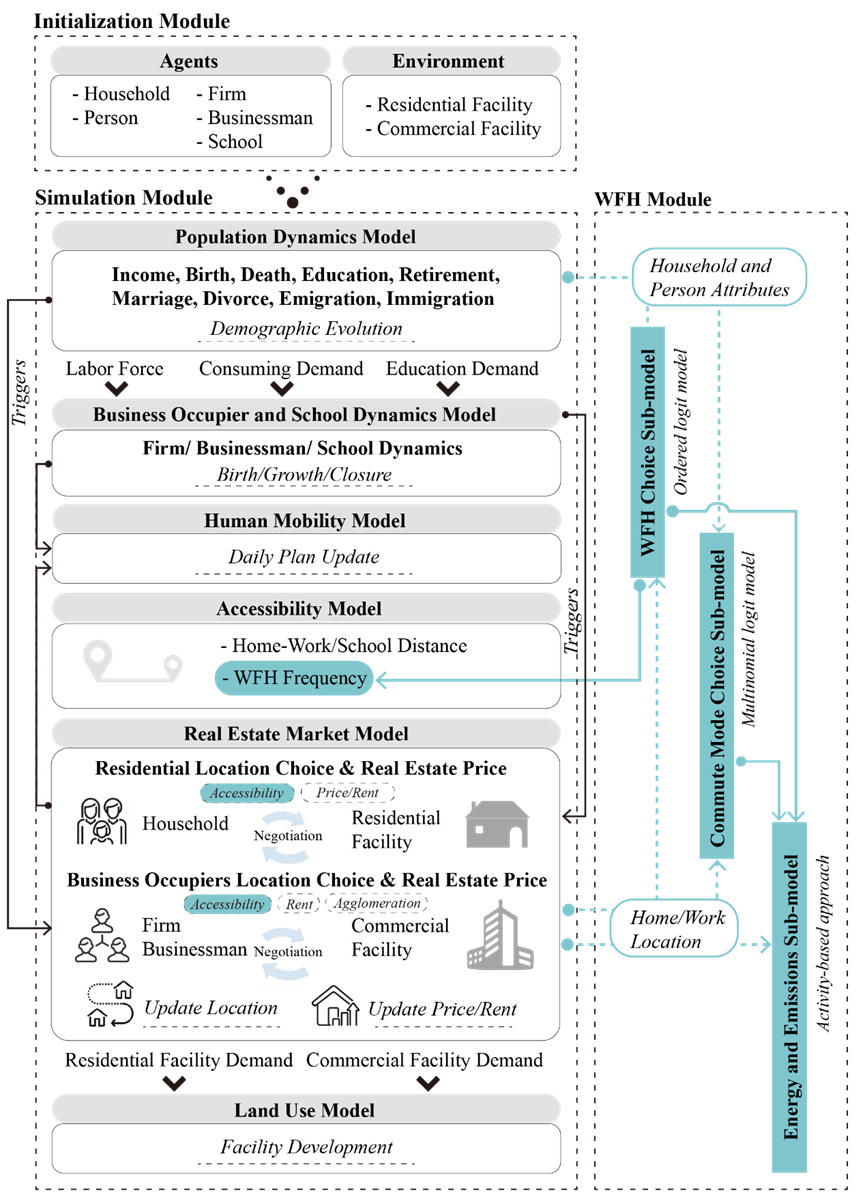
Framework of SelfSim-WFH
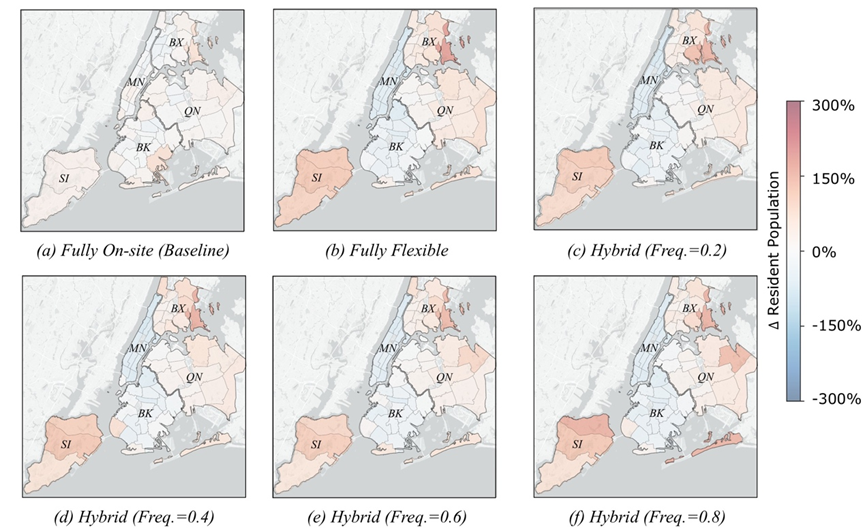
Simulation results: Community District-Level Total Resident Population Change from 2020 to 2035 under Different Scenarios
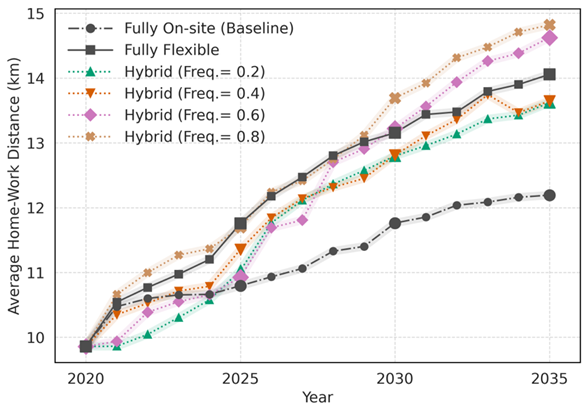
Simulation results: City-level Average Home-Work Distance by Year under Different Scenarios